

Some links in this article are affiliate links. We may earn a commission if you make a purchase through them, at no extra cost to you. This does not influence our reviews.
Every "Instantly vs Lemlist" article on the first page of Google tells the same bedtime story. Instantly is for scale. Lemlist is for multichannel. Pick your adventure. What none of them do is run the numbers for a real agency with five clients, 25 mailboxes, and a Slack channel full of people asking why replies dropped.
That is the piece I wanted to write. Not another feature checklist. The actual invoice math, the deliverability stuff vendors keep overselling, and the third option (Smartlead) that r/coldemail keeps bringing up while comparison blogs pretend it does not exist.
Quick context: Google's 2024 bulk-sender update made SPF, DKIM, DMARC, complaint rate control, and one-click unsubscribe table stakes. Not advanced ops. Baseline. If your DNS is wrong, no software fixes that. Both Instantly and Lemlist talk about deliverability like their product is the answer. It is not. Setup is the answer. Software just makes the execution less painful.
The no-BS feature matrix
| Feature | Instantly | Lemlist | The gotcha |
|---|---|---|---|
| Best for | Email-first agencies | Small multichannel teams | People with clean setup |
| Starting price | $47/mo Growth | $63/user/mo annual | Both get fatter later |
| Inbox model | Unlimited email accounts | Seats + $9 extra sender | One scales, one compounds |
| Channels | Email only | Email, LinkedIn, calls | More channels don't fix inboxing |
| Lead database | 450M+ via SuperSearch | 600M+ built in | Data quality still varies |
| Warm-up story | Warmup + SISR | lemwarm | Helpful ramp, not magic |
| Unified inbox | Unibox | Email Hub | You still need CRM logic |
| Agency math | ~$97 lean / ~$281 loaded | ~$495 to $615 | Margins hate seat stacking |
| Lock-in risk | DFY domains stay with Instantly | Seat and sender creep | Convenience costs control |
| Action | Try Instantly | Try Lemlist | - |
Short version: Instantly wins if your world is pure email volume and agency margins. Lemlist wins if LinkedIn steps are a real part of your process every single week. Most teams like the idea of multichannel more than they actually use it.
The deliverability illusion
Let's kill the main myth first.
Neither Instantly nor Lemlist solves deliverability. Gmail's own sender guidance still starts with SPF, DKIM, and DMARC. If your domain is three weeks old, your complaint rate is climbing, or your list is full of scraped nonsense, no warm-up network is going to carry you. Warm-up pools in 2026 are basically astrology with an invoice attached. They smooth the ramp. They don't create trust from thin air.
Instantly leans on something called SISR (Spam in Spam Removal) and its sending infrastructure story. Lemlist leans on lemwarm. Both helpful for ramping new inboxes. Neither is a shield.
The Lemlist catch is easier to prove because their own help docs spell it out: use a custom tracking domain, lower volume if Google starts flagging, and turn off open tracking on short emails. That last one is the tell. If the vendor's own documentation says "disable this feature or you'll land in spam," maybe the feature is the problem.
Instantly is cleaner for plain-text outbound because email is the whole product. No LinkedIn pixel soup, no extra tracking clutter. But if your DNS is sloppy and your offer is "hi [firstName], I noticed your company," the spam folder still wins. Software can't rescue lazy.
Feature breakdown: where the workflows actually differ
Volume scaling vs multichannel
Does it actually save time or just look cool?
That is the whole filter. Instantly is built for teams that care about mailbox count, sending volume, and reply routing. Lemlist is built for teams that want email, LinkedIn, and task handoffs inside one surface. One is throughput. One is workflow packaging. If you're an agency living on inbox rotation and deliverability hygiene, Instantly is closer to what you need. If you're managing a rep workflow where LinkedIn touches happen daily (not "we'll add that later"), Lemlist still fits better.
That split sounds obvious. It decides the bill.
The unified inbox, and who gets buried in it
Both tools know reply chaos kills campaigns. Instantly's Unibox is cleaner for email-only operators because it doesn't try to be anything else. Lemlist's Email Hub makes more sense for rep teams working across channels, especially when outbound sits next to follow-up work in your project management stack.
Instantly gives ops people less clutter. Lemlist gives reps more context. Pick the wrong one and your team either drowns in tabs or pays for context nobody opens.
AI personalization and custom images
Instantly treats AI like an add-on economy. The writing and reply layer exists, but it sits behind a separate credit model that starts at $47/mo on top of your sending plan. Lemlist's personalization pitch is flashier, with custom images and multichannel variables that look great in demos.
Here's the thing: text that sounds human beats a personalized image gimmick almost every time. If you need a custom screenshot of someone's LinkedIn profile embedded in your email to get a reply, the offer needs work. Not the tooling.
Worth noting: Instantly's AI credits run on a separate billing tier from your sending plan. You can burn through a $47 credit pack in a week if you're generating first lines and auto-replies across four or five client campaigns. Lemlist bakes its AI features into the seat price, which sounds simpler until you remember the seat price is already $63 to $87 per user. Neither approach is free. One hides the cost in credits, the other hides it in headcount.
Instantly: the volume play
Unlimited email accounts. That is the pitch everyone remembers, and for agencies it matters more than most features on a comparison grid. Inbox count is what turns outbound from side project into system.
The app itself is fast. Unibox makes sense, the sequence builder stays out of your way, and the UI wastes less screen real estate than Lemlist. If your workflow is "send from 20 to 40 inboxes, route replies, push warm leads into a CRM with Zapier, Make, or n8n," Instantly fits that shape better than anything else at this price point.
Now the bill. The app plans handle sending, but the data and AI layer runs on separate credit packs: $47, $97, and $197 per month. Lead verification burns 0.25 credits each. AI replies cost 5 credits. So yes, Instantly can be cheap. It can also turn into a credit casino the second you start using SuperSearch, bulk verification, and AI writing across multiple client campaigns.
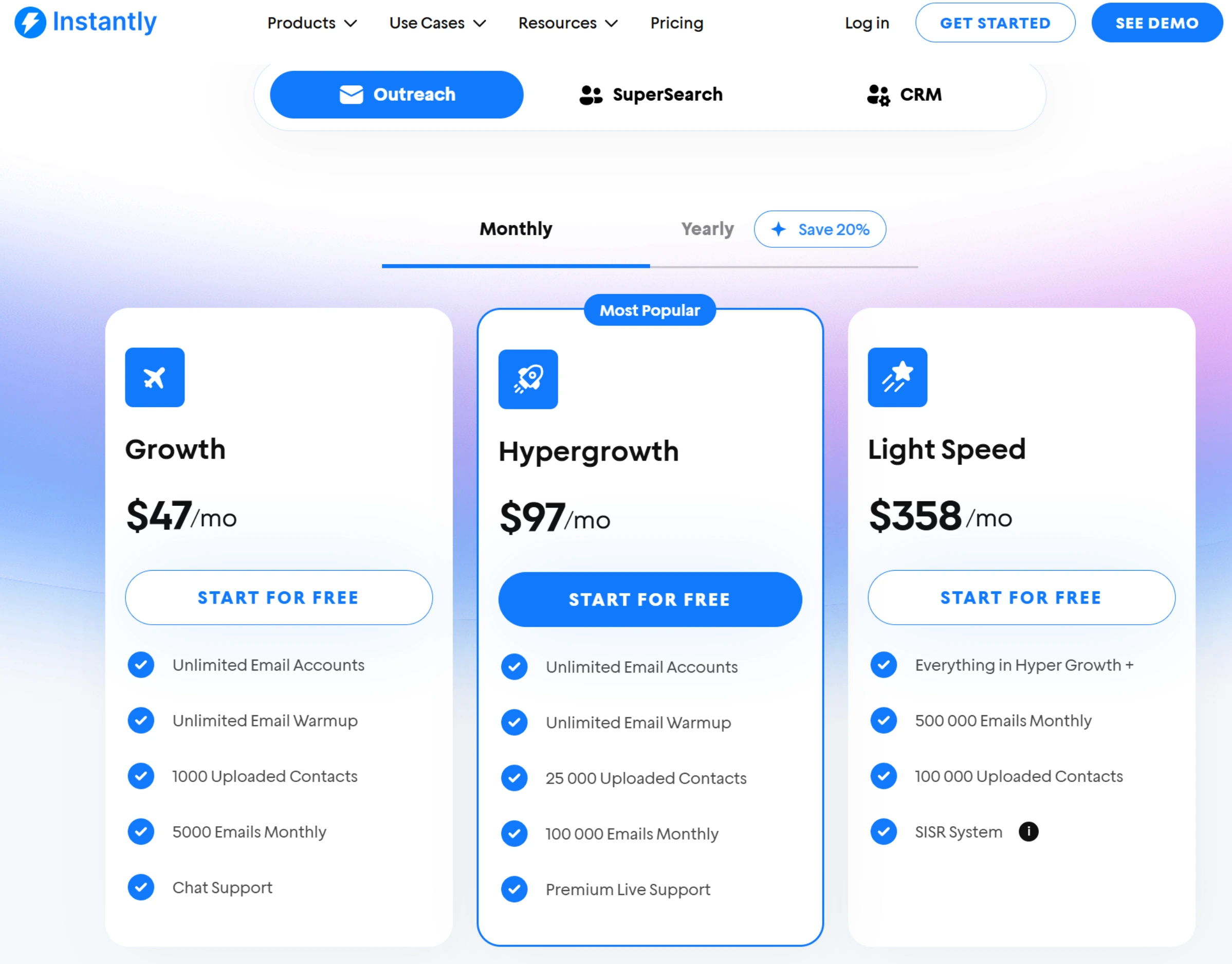
The bigger red flag is the DFY domain program. Instantly's own help docs say domains bought through that service are not owned by you and cannot be transferred out. Read that again. You're paying for domains you don't control. That's not a footnote. That's a lock-in strategy disguised as convenience.
Unlimited email accounts on every plan is the main reason agencies keep choosing it over per-seat billing competitors.
Teams who want one vendor for senders, domains, data, AI, and CRM, since the credit add-on ecosystem gets expensive fast.
- Unlimited email accounts on every plan — the main reason agencies keep looking at it
- Growth at $47 and Hypergrowth at $97 are far easier to justify than per-seat billing once inbox count climbs past 10
- SuperSearch adds a 450M+ lead database if you want built-in data instead of paying for Apollo or Clay separately
- Unibox stays out of the way when the team only cares about sending, replies, and routing
- Credits are separate from sending plans ($47-$197 tiers), so the real monthly cost is higher than the headline price suggests
- Verification at 0.25 credits and AI replies at 5 credits each burn fast across multiple client campaigns
- DFY domains stay under Instantly's control and cannot be transferred — the biggest lock-in warning in this category
- Outgrowing the included 25k contacts / 125k emails means another $87/mo add-on
Use it if you already understand inbox setup and want the cleanest math for pure email scale. Skip it if you want one vendor for senders, domains, data, AI, and CRM. That's where the cheap story falls apart.
Lemlist: the multichannel play, with agency tax
If your reps truly live in LinkedIn, not "we'll add LinkedIn steps eventually" but actually live there, Lemlist still has the best integrated workflow. Email, LinkedIn touches, and call tasks inside one sequencer. The personalization layer goes further than Instantly with custom images, landing pages, and multichannel flows that look polished in SDR team demos.
That polish is real. So is the invoice it creates.
Public pricing: $63 per user for Email Pro, $87 per user for Multichannel Expert, annual billing. Then the add-ons. Extra email senders at $9 each. Deliverability Boost at $20 per user. WhatsApp at $29 per user. This is why the word "tax" keeps showing up in r/coldemail threads about Lemlist. The moment you need more than one user, the starting price is a memory.
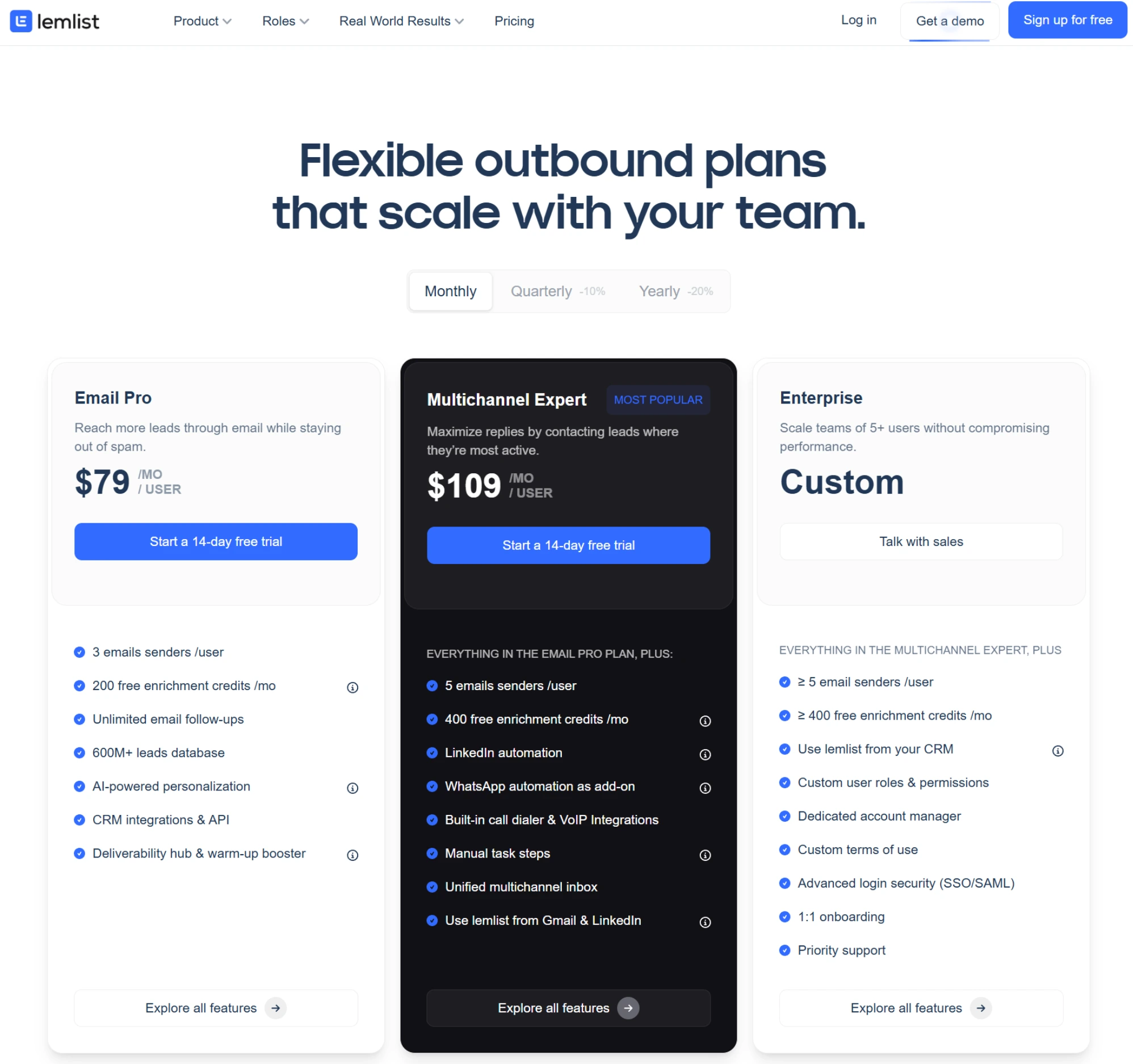
r/coldemail and r/sales tell the same story on repeat: people praise the multichannel workflow, then complain that support drags and the seat stack gets absurd once a team grows past two. That pattern shows up too often to dismiss.
Email, LinkedIn, and call steps living in one sequence builder is still the best integrated multichannel workflow available.
Agencies buying seats for ops people who mostly need inbox scale, since the seat model compounds to $495-615 fast.
- Email, LinkedIn, and call steps live in one sequence builder — still Lemlist's biggest edge and the reason people pay the premium
- Built-in lead database pitched at 600M+ contacts, so list sourcing lives in the same app
- Custom images and multichannel personalization are better suited to SDR teams than Instantly's plain email workflow
- The interface is easier to hand to reps who don't want to think about infrastructure or DNS
- Seat pricing is the whole problem — $63 to $87 per user before you start stacking sender add-ons
- Extra senders at $9 each push agency setups into $495-$615 territory faster than most buyers expect
- Their own help docs tell you to disable open tracking on short emails if Google flags the account — that's a feature admitting defeat
- If you only need email volume, half the product becomes expensive decoration you're paying for but not using
Use it if LinkedIn and email genuinely belong in the same rep workflow. Skip it if you're an agency buying seats for ops people who mostly need inbox scale.
The real pricing math for a 5-client agency
This is the section most comparison pages skip. It ruins the clean narrative.
- Instantly, lean: Hypergrowth at $97/mo handles sending with unlimited email accounts. If you already own 25 mailboxes in Google Workspace or Microsoft 365, that's your real starting point. $97 flat.
- Instantly, loaded: Add a $97 credit pack for data and AI, plus the $87 sending-capacity add-on when you outgrow 25k contacts. Now you're at $281/mo before any DFY or pre-warmed accounts.
- Lemlist, email-only: Five Email Pro seats at $63 is $315. But five seats rarely means five inboxes. Add 20 extra senders at $9 each. That's $495/mo on annual billing.
- Lemlist, multichannel: Five Multichannel Expert seats at $87 is $435. Same 20 extra senders pushes it to $615/mo. Before WhatsApp. Before Deliverability Boost.
$97 vs $495. That's not a rounding error. That's a margin conversation.
One boundary matters here. Cold outbound is not newsletter software. If you're pricing lifecycle campaigns or broadcasts, you want our email marketing tools comparison instead. Buying Lemlist to do MailerLite's job is how agencies waste money.
The Reddit reality check
The blog version of this comparison says Instantly is for scale and Lemlist is for personalization. The r/coldemail version is rougher.
Instantly gets praise for raw scaling and less love for the credit ecosystem. Multiple threads call out the DFY domain lock-in specifically. The product can be cheap. The upsell orbit around it often is not. One user put it bluntly: "Instantly is a $97 tool that wants to be a $400 platform."
Lemlist gets the opposite pattern. People like the multichannel flow, then start groaning when the seat model compounds past three users. Support responsiveness comes up a lot. And open-rate talk keeps showing up in r/sales meetings that should be about replies and booked calls.
Hot take: open rate is the vanity metric that refuses to die. In 2026, with Apple Mail Privacy Protection spoofing opens on every device, chasing open rate is chasing noise. A reply from the right prospect is the only number that matters.
Second hot take: if your vendor controls the domains and the sender identities, you're renting your outbound stack. You're not building one. And rent goes up.
If your team is also logging into client LinkedIn accounts for Lemlist sequences, keep the IP side clean. A dedicated endpoint from one of our best VPNs is cheaper than explaining a restricted client account to a paying customer.
The 3rd option nobody wants to talk about
Smartlead. Starts at $39 on Base and $94 on Pro, with unlimited mailboxes from day one. Not "unlimited on the enterprise plan." On every plan. The top public tier now reaches $174/month, which still lands below what Lemlist turns into once sender add-ons start stacking.
The higher tiers add private sending infrastructure, a central master inbox, and white-label controls that actually make sense for agencies instead of another round of seat multiplication. r/coldemail brings it up constantly. Threads asking "Instantly or Lemlist?" now get replies saying "neither, look at Smartlead" often enough that ignoring it felt dishonest.
You get the scale-minded, email-first approach of Instantly without the credit sprawl. You don't get Lemlist's native LinkedIn workflow. But a lot of agencies have already decided they'd rather pair Smartlead with a separate LinkedIn tool than keep paying Lemlist's seat tax for features half the team never touches.
Smartlead's API is also substantially more open than either competitor. Teams running custom CRM pipelines through HubSpot or Salesforce webhooks report cleaner integrations than trying to pipe Instantly's data through Zapier workarounds. On r/Emailmarketing, the consensus is that Smartlead's webhook layer behaves more like developer tooling than a marketing SaaS bolt-on.
Not the universal winner. If your reps live inside LinkedIn and that workflow is non-negotiable, Lemlist still fits better. But for technical teams and agency ops people who care about inbox count, webhooks, and white-label control? Smartlead is the grown-up room.
Base plan at $39 includes unlimited mailboxes from day one, changing the margin math for agencies running 20+ inboxes.
Teams where native LinkedIn sequencing is non-negotiable, since Smartlead has no built-in LinkedIn workflow.
- Base at $39 includes unlimited mailboxes — instantly changes the margin math for agencies running 20+ inboxes
- Pro and higher plans are built around agency workflows with a master inbox and webhook-driven automation
- Private infrastructure and white-label options make more sense for advanced operators than Lemlist's sender add-on model
- No native LinkedIn sequencing, so multichannel teams still need separate tooling like Expandi or Dripify
- Smaller brand footprint means fewer reps know the product and onboarding takes longer
- Won't rescue bad domains, bad copy, or bad lead hygiene — same as the other two, just cheaper while it doesn't work
Use it if you want scale plus backend control without the credit casino. Skip it if native LinkedIn steps are the main thing keeping your outbound machine alive.
Final verdict
Solo founder: Lemlist only if you use LinkedIn steps every week. Not "plan to." Use. If not, you're paying for workflow polish you'll never touch.
Agency running 15+ inboxes: Instantly. The margin math is cleaner and that matters more than a prettier campaign builder.
Ops team that cares about plumbing: Smartlead. Where advanced users land when Instantly's credit tiers start feeling like a mobile game.
Enterprise or compliance team: None of these blindly. Your deliverability floor is DNS, list quality, and process. Software sits on top of that, not instead of it.
Winner for most readers: Instantly. Not because it's magic. Because $97 for unlimited inboxes is the least expensive way to run serious email volume if you bring your own mailboxes and stay disciplined about credits. Smartlead is the better escape hatch for technical teams. Lemlist is still good, and sales teams like it, but the seat model makes the math ugly fast.
Pick one and fix your DNS first.